13.5.10

PELEE - MAY 9th

After yesterday's horrendous conditions Kathi and I got an early start and enjoyed a good breakfast at Paula's Fish Place just north of the park gate. As we were leaving Paula pointed out a group of swallows sunning on the sheltered side of the restaurant. There were at least fifty lethargic individuals trying to get warm.


CLIFF SWALLOW is a scarce breeder in Essex County. However there were at least fifteen perched on the eavestrough of the restaurant this morning including this co-operative individual.

PELEE - MAY 6TH

I had Thursday May 6th 'off' so I spent the morning photographing. It was a bit challenging with all the big guns running around and many whose behavior bordered on down right ignorant. I wont be politically incorrect, but suffice it to say they come from one particular region of Canada! I waited patiently for this WHITE-EYED VIREO to show and should have nailed it. However two different groups attacked the bird from off trail and it spooked.


I spent a fair bit of time taking pics of people this morning because there were relatively few songbirds. However, the large group of COMMON TERNS on the tip put on a great show and took flight and wheeled overhead several times.


It was fun watching the TERNS and some of them were even courting. This individual is carrying a small fish (likely a smelt) - a common behavior during courtship.


4.5.10

PELEE - May 4th

I spent the morning taking photos around Point Pelee. The weather was good for photography but unlike the last two days, there were very few migrants. I decided to focus on other subjects and there was no shortage of those! The early morning was spent photographing MayApple and other plants, most of which had a nice coating of dew or water droplets.


The birds were not flying but with the sunny mild conditions, it was a good day for butterfly activity. Among the species seen were my first MONARCH of the year. This AMERICAN PAINTED LADY was one of several dozen seen. Most were feeding on flowering GARLIC MUSTARD.


When the opportunities popped up, I did manage to get some images common breeders. Although the background is a bit busy, I liked this image of a co-operative male AMERICAN ROBIN.


3.5.10

PELEE - May 3rd

It was another GREAT day at Pelee with numbers still low but diversity and quality both superb. After overnight rain, it cleared and we were treated to a gorgeous sunny and warm day. We started at the Tip with the highlight certainly being no fewer than a dozen RED-HEADED WOODPECKERS! It was like the good old days when this bird was seen frequently at the tip. At one point we had SIX RED-HEADED and SIX RED-BELLIED WOODPECKERS in the same tree!! Other tip highlights included perfect close low views of WHITE-EYED VIREO and a text book study of CLAY-COLORED SPARROW feeding in the open with two FIELD SPARROWS.

Our next stop was the Woodland Nature Trail. The northeast corner produced again today with top honours going to a close male HOODED WARBLER, a LOUISIANA WATERTHRUSH (distant but clear views), two or three BLUE-WINGED WARBLERS (including one with yellow wing bars), and a really co-operative OVENBIRD. The big warbler highlight of the day was a YELLOW-THROATED WARBLER found by my good friend Bruce DiLabio near the park entrance. We had several decent views of the rare southerner. Rounding out good warblers were the same male PRAIRIE WARBLER at our picnic lunch stop at the Dunes (along with a wide open YELLOW-BILLED CUCKOO).

2.5.10

PELEE - MAY 2nd


Today was the first day of my Pelee bird hikes and we had a GREAT day. There weren't huge numbers of birds but we had really great views and good diversity and quality. Among the 15 warbler species we observed were a male WORM-EATING WARBLER (stunning close views, we finally walked away from the bird!), a male HOODED WARBLER (scope views of a preening male!), PRAIRIE WARBLER (a great view of a close male at fifteen feet), BLUE-WINGED WARBLER (at least 8 singing males studied at length), NORTHERN WATERTHRUSH (incredible leisurely studies of at least six different individuals), a low close male CAPE MAY WARBLER, and a single male BAY-BREASTED WARBLER. Incredibly, we had only ONE Yellow-rumped Warbler all day. I am sure this is certainly the first time in 39 years of birding at the park that I have seen 8x more Blue-winged Warblers than Yellow-rumped Warblers in a day!!! Tomorrow the forecast looks good for more great birding. Can't wait.

20.4.10

TEXAS - GOODBYE AND WRAP UP

Our week long tour of Hill Country and south Texas ended on a high note with good looks at White-collared Seedeater, several male Blue Grosbeaks on territory, a male Cinnamon Teal, and a great look at a male Black-tailed Gnatcatcher.

Here is a pic of the Black-tailed Gnatcatcher. Not a a great shot, but this is a hard species to photograph in south Texas!


The only low point in the trip was arriving at the entrance road to 75 acre pond in Choke Canyon State Park. There was a barrier being put up by two female park rangers. I asked if we could get to the pond (where a Northern Jacana had been for several months) and was told abruptly NO. I asked where we could park to walk down the road and they said we couldn't even walk on the road! When I told them we had driven a long way just to look for the Jacana they said go look elsewhere in the park. The reason for the closure was the parking lot was flooded! The two staff members left a sour taste in our mouths about the state parks. All too often these government staff completely forget that they are supposed to be public servants!

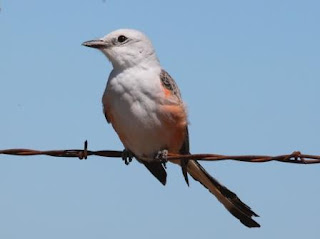
On our final morning we drove back to San Antonio from Three Rivers. It is only about an hour and a half drive but we had fun counting Scissor-tailed Flycatchers. The tally was a remarkable 111 for the drive. At this time of year it is not unusual to see hundreds on a daily basis. Nonetheless one never tires of this gorgeous bird.


Also seen were a male Blue Grosbeak, 16 Crested Caracaras, and incredibly an Audubon's Oriole! We turned around and got better views of a pair of orioles including one gathering nest material. Here is an image of one bird which was perching atop a mesquite at the side of the road.


We ended the trip with an excellent total of 265 species - a reflection of the incredible spring birding in Hill Country and South Texas in April!

17.4.10

TEXAS VALLEY SPECIALTIES


Today was a day for cleaning up the gaps in the list for the lower valley. We had seen both Hook-billed Kite and Clay-colored Robin at Santa Ana a few days before, but also wanted better views. Luckily at Anzalduas we managed to get not only better views of the kite, but also added at least 120 Mississippi Kites, and a male Painted Bunting watched in the scope as it bathed in a puddle in the road. At the North American butterfly park we added White-tailed Kite for our third kite species of the day and finally got much better looks at Clay-colored Robin. This one surprised me by singing well into the morning (at least until 10:30 am). If it hadnt been singing it would have been next to impossible to see. This is typical of the breeding season when these birds become much more secretive and sneaky.


In the heat of the day, we took a break and then in the late afternoon headed to the area around Salineno and Chapeno. There were at least three Red-billed Pigeons perched up for scope views on the island at Salineno. On the back road out of town I was truly surprised to come across at least four SCALED QUAIL including this singing male in a small mesquite. This species has been really tough in recent years, so this was a nice bit of luck to wrap up the day!